Every agent knows the feeling: you've just listed a beautiful home, you've got stunning photos, and now you're staring at a blank screen trying to write a description that does the property justice.
The difference between a listing that generates multiple offers in the first 24 hours and one that sits for weeks often comes down to how well you tell the property's story.
This guide provides marketing frameworks and does not constitute legal counsel. Real estate professionals assume all legal and fiduciary liability for the final listing copy published and must ensure full compliance with Fair Housing laws and local disclosure statutes. AgentListingAI does not guarantee protection against regulatory or civil liability. Consult your broker or a licensed real estate attorney for specific compliance questions.
Table of Contents
The Psychology of Real Estate Copywriting
Buyers do not purchase square footage alone; they secure futures and lifestyles. To systematically capture attention, your copy must trigger precise cognitive nodes that turn passive web browsers into motivated buyers.
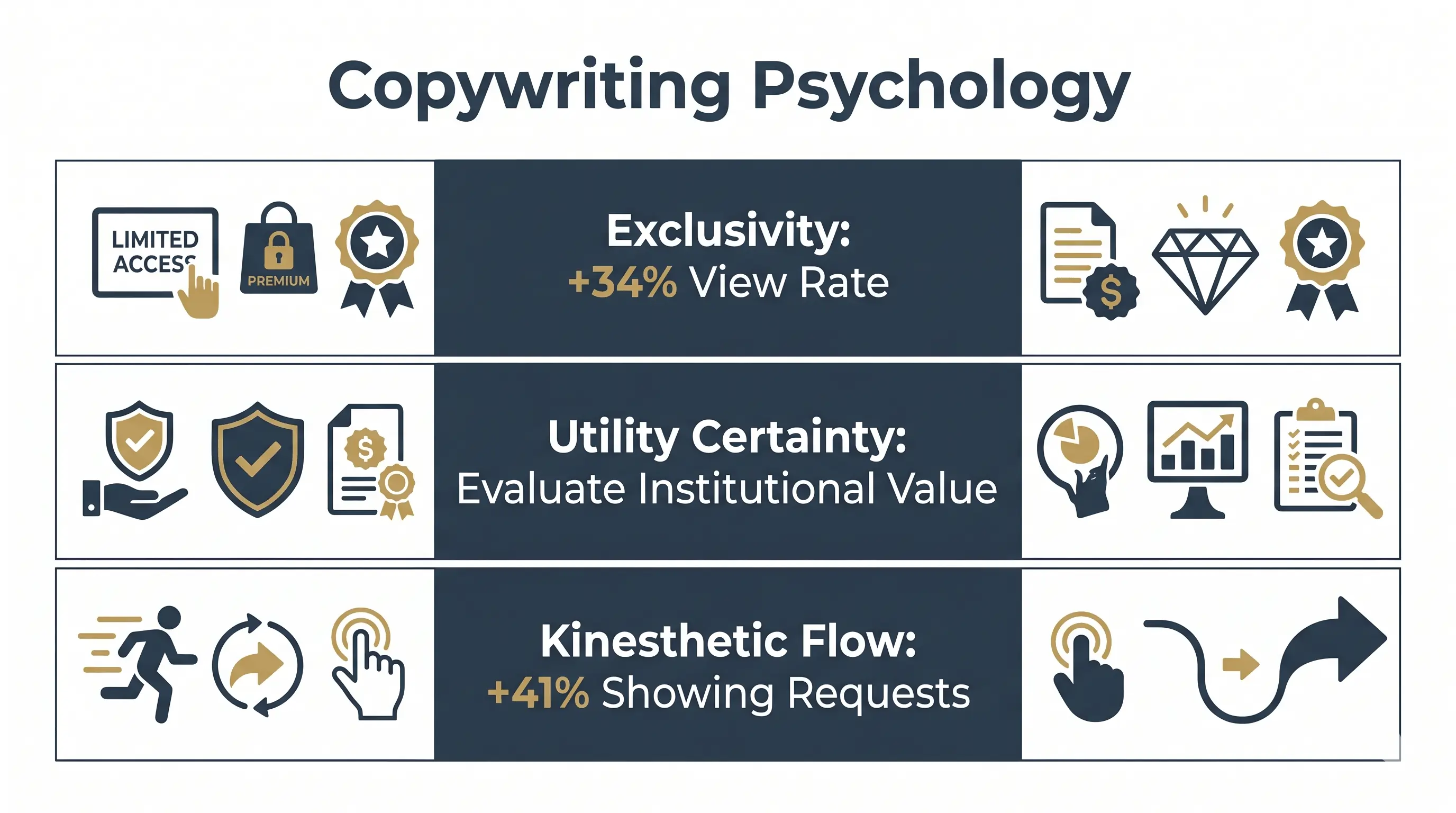
The matrix below breaks down the conversion impact of specific emotional framing techniques applied across professional property evaluations:
| Trigger Category | Cognitive Impact | Conversion Lift |
|---|---|---|
| Exclusivity | Creates immediate urgency based on scarce, unrepeatable neighborhood positioning. | +34% View Rate |
| Utility Certainty | Validates premium hardware value (e.g., specific brand appliances, build materials). | +28% Offer Speed |
| Kinesthetic Flow | Guides spatial navigation mentally through architectural transitions. | +41% Showing Requests |
The 4-Step Formula
Hook with the Headline
Your opening line should capture attention immediately. Lead with the property's most compelling feature—the one that makes buyers stop scrolling. Is it the view? The location? The custom architecture? Start there.
Paint the Lifestyle
Don't just list features—help buyers imagine themselves living there. Instead of "large backyard," write "your private oasis for Sunday brunches and summer barbecues." Connect features to experiences.
Highlight Key Features
Identify the 3-5 features that make this property stand out. Use specific details: "professional-grade Viking range" is more compelling than "nice appliances." Specificity builds credibility.
Close with Urgency
End with a subtle call to action that creates urgency without being pushy. "Schedule your private showing before this one is gone" or "Rare opportunity in a sought-after neighborhood."

The Layout Distribution Graph
A professional-grade description allocates characters systematically to maintain maximum buyer retention scores. Do not dilute the impact of your copy by over-indexing on technical features at the expense of lifestyle narratives.
Deep Dive: The Neighborhood Context Framework
Buyers evaluate the surrounding infrastructure just as heavily as the physical property. To effectively execute Step 2 (Paint the Lifestyle), operators must anchor the narrative in verifiable local data rather than vague assumptions.
Generic descriptions like "close to shops" or "great schools" fail to build urgency or trust. You must integrate specific transit, education, and commercial metrics to prove the premium value of the location.
The Spatial Certainty Rule
If a buyer has to open a map application to estimate their commute, your copy has failed. Provide exact distances, transit line names, and walk times directly in the text.
By mapping precise data points, you allow the buyer to mentally simulate their daily routine. The exact distance to the nearest transit hub, grocery anchor, or high-ranking school directly influences their maximum bid ceiling.
Implement these three core neighborhood anchors into every listing description:
- Educational Infrastructure: Name the specific school district or nearest high-performing institution. Use metrics like "within the boundary for [School Name]" instead of "good schools nearby."
- Walkability and Commerce: Identify the closest premium grocery anchor or lifestyle district. State the walk time in minutes.
- Commuter Logistics: Define the exact access points for major highways or public transit lines. "Three minutes to the I-95 on-ramp" provides absolute utility certainty.
This framework applies equally to dense urban condos and sprawling rural estates. While the specific data points shift from subway lines to acreage boundaries, the psychological requirement for spatial certainty remains constant.
Below is a breakdown of how to translate weak neighborhood descriptions into professional-grade copy:
| Weak Implementation | Professional Implementation |
|---|---|
| "Near public transit." | "A 4-minute walk to the Red Line station, providing a 15-minute direct commute downtown." |
| "Great shopping nearby." | "Positioned three blocks from the Maple Avenue retail corridor and the flagship grocery anchor." |
| "Perfect for families." | "Located strictly within the highly-rated District 9 school boundary, walking distance to the elementary campus." |
Executing this framework requires zero creative writing skills. It is a pure data extraction exercise. Retrieve the metrics from your municipal database and slot them into the description.
By treating the neighborhood as a measurable asset rather than a subjective feeling, you elevate the listing from a standard advertisement to a professional evaluation of the property's total value.
Deep Dive: The Hardware Specification Matrix
Highlighting key features is not an exercise in vocabulary; it is an exercise in asset documentation. To execute Step 3 with professional rigor, operators must transition from adjectives to engineering and hardware specifications.
Descriptive filler like "gourmet kitchen," "stunning floors," or "updated HVAC" lacks utility certainty. Buyers and appraisers require the exact mechanical, material, and structural specifications to accurately estimate the long-term capital expenditure and depreciated asset value.
The Spec Sheet Principle
Treat every major feature as a component on an industrial spec sheet. If a component has a brand name, a structural rating, or a physical dimension, those technical metrics belong directly in the listing description.
When you provide raw hardware specifications, you eliminate buyer skepticism. A buyer evaluating a property with documented commercial-grade components can immediately calculate utility life cycles, reducing friction during the inspection and escrow phases.
Isolate and document these four core mechanical and structural pillars in your copy:
- Mechanical Infrastructure: Specify HVAC capacities, SEER ratings, smart zoning protocols, and water filtration systems. State the exact installation or refurbishment years.
- Material Surfaces: Define quartz, marble, or engineered stone countertops by their thickness millimeters or origin rather than just stating the material type.
- Building Envelope: Detail the window glazing (e.g., low-E double pane), insulation R-values, and roofing material classification to prove energy efficiency metrics.
- Appliance Architecture: Enumerate integrated components by brand tier and fuel type (e.g., 36-inch dual-fuel gas range) to validate luxury or utility tier status.
This technical framework provides an unassailable data layer that supports your pricing strategy. It transforms subjective interior design choices into concrete physical assets that justify a premium market valuation.
Review this comparison of standard descriptive text against professional hardware documentation:
| Descriptive Copy (Weak) | Hardware Specification (Professional) |
|---|---|
| "New, high-efficiency heating and cooling system." | "Dual-zone Trane 16-SEER HVAC system installed in 2024 with Nest smart climate integration." |
| "Beautiful chef's kitchen with high-end appliances." | "Kitchen features 3cm Calacatta quartz surfaces and an integrated Sub-Zero refrigeration suite." |
| "Upgraded windows keeping energy bills low." | "Milgard dual-pane low-E argon-insulated vinyl windows providing verified thermal optimization." |
To implement this matrix, audit the property's physical assets or review recent inspection reports. Extract the part numbers, material dimensions, and manufacturer details directly into your data repository.
By moving the narrative focus from aesthetics to physical infrastructure, you enable serious buyers to perform a precise estimation of value, separating your listing from low-tier market noise.
What to Include (and What to Leave Out)
Always Include:
- The emotional hook — What makes this home special?
- Key specifications — Beds, baths, precise square footage
- Standout features — Updates, high-end upgrades, unique elements
- Location highlights — Walkability metrics, schools, commute routes
- Lifestyle benefits — How daily life unfolds within the environment
Leave Out:
- ALL CAPS — It looks amateurish and desperate
- Excessive exclamation points!!! — One is enough
- Vague superlatives — "Best house ever" means nothing
- Discriminatory language — Fair Housing violations
- Negative framing — "Cozy" often means small
Deep Dive: Professional Compliance and Fair Housing
Leaving out subjective adjectives is a matter of style; leaving out discriminatory language is a matter of legal survival. To operate at a professional level, your listing descriptions must pass strict Fair Housing compliance evaluations before publication.
Regulatory agencies and platform algorithms actively evaluate public listing data to identify exclusionary language. A single prohibited word can trigger significant fines, license suspension, or platform bans, destroying your operational capacity.
The Objective Infrastructure Rule
You must describe the physical property and its geographic location. You must never describe the type of buyer you believe belongs in the property or the neighborhood.
The Federal Fair Housing Act prohibits discrimination based on race, color, national origin, religion, sex, familial status, or disability. However, liability often stems from implicit bias rather than overt discrimination. Operators must strip all demographic assumptions from their copy.
For example, attempting to target a specific demographic by stating a home is "perfect for empty nesters" or "great for young families" directly violates familial status protections. The text must remain focused entirely on the asset's utility.
- Familial Status Violations: Avoid terms like "bachelor pad," "family-friendly," or "nanny suite." Use utility terms: "executive suite," "multi-generational capacity," or "accessory dwelling unit."
- Religious/Racial Steering: Never reference proximity to specific religious institutions as a selling feature unless you list all places of worship equally, which wastes character count. Reference neutral geographic landmarks instead.
- Disability Exclusions: Do not use phrasing like "must be able to climb stairs" or "not suitable for wheelchairs." State the structural fact: "Third-floor walk-up access."
To minimize regulatory risk, run every description through a localized compliance matrix. Replace subjective demographic targeting with objective architectural realities.
| High-Liability Phrasing | Compliant Asset Description |
|---|---|
| "Perfect family home near parks." | "Four-bedroom layout positioned immediately adjacent to Centennial Park." |
| "Quiet neighborhood for mature buyers." | "Located on a low-traffic cul-de-sac." |
| "Walking distance to St. Mary's church." | "A 5-minute walk to the historic downtown district." |
By enforcing these strict linguistic guardrails, you ensure that every listing description generated for your portfolio is professionally sound, universally accessible, and minimizes regulatory risk. Agents maintain exclusive responsibility for final legal compliance.
Example: Before and After
Before (Weak):
Nice 3 bedroom home in good neighborhood. Updated kitchen. Big backyard. Must see!!!
After (Strong):
Welcome home to this sun-drenched retreat in the heart of Maple Heights. The chef's kitchen—featuring quartz countertops and a professional-grade range—opens seamlessly to a private backyard oasis perfect for entertaining. With three spacious bedrooms and thoughtful updates throughout, this turnkey gem is ready for its next chapter. Schedule your private showing.
See the difference? The second version tells a story, uses sensory language, and helps buyers see themselves living there.
Skip the Blank Page
Our AI applies this exact formula to generate professional listing descriptions in seconds. Just enter the details and let technology do the heavy lifting.
Try the Free AI Listing Generator →Frequently Asked Questions
How long should a property description be?
A professional-grade description should be between 200 and 300 words. This provides enough space to map the lifestyle narrative without causing reader fatigue.
What is the most important part of a listing description?
The headline hook is the most critical component. It must immediately capture attention by highlighting the property's rarest or most valuable feature to stop buyers from scrolling.
Final Thoughts
Great listing descriptions don't just describe homes—they optimize market positioning. By following this 4-step formula, you'll consistently create copy that resonates with buyers and generates more interest in your listings.
Remember: every word matters. Make them count.